How Do You Install Gdb For Mac
Installing G on a Mac This section is intended to get you quickly started with C programming on your Mac. We'll be installing GCC 4.8.1 and GDB through a tool called Homebrew.
If you want an additional guide on all of the following steps (except for installing GCC), the is quite helpful. When you follow it, ignore anything about installing Ruby; that is, stop after setting up git. Homebrew 'installs the stuff that you need that Apple don't'. It's like Ubuntu's apt-get, where one can install packages easily from repositories. Instead of having to download, configure, and install something yourself, all you need to do is run one command, and Homebrew will take care of the rest for you.
Pre-requisites Homebrew requires that you have either or the installed on your Mac. Xcode is a free integrated development environment similar to Eclipse designed by Apple and mainly intended for iOS development or targeting the clang compiler. In this class, we will focus on gcc.
Xcode is quite a big install, so if you do not want to install it, you can get away with just installing the Xcode command line tools. See a for instructions on how to install the command line tools regardless of whether you have Xcode installed. Installing Homebrew You need xcode command line tools to install Homebrew. It is very easy to install Homebrew. Open your terminal, and run the following command. Ruby -e '$(curl -fsSL If this doesn't seem to do anything, try killing it (CTRL C) and running it again. Or checkout website.
GCC and GDB Installing GCC As mentioned before, installing packages with Homebrew is very easy. First, we will add the repository from which the GCC package is available, so that Homebrew knows where to find the package we want. The repository is at. Top 5 alternatives to rival knights for mac pc. We do this by using the brew-tap command.
Keep your terminal open, and run the following command. (For more information on how brew-tap works, visit the ). Gcc-4.8 (GCC) 4.8.1 Copyright (C) 2013 Free Software Foundation, Inc.
Gdb On Mac
USC Wireless Warning Many people have had issues running the brew install commands while connected to USC Wireless. If you are having trouble, you can either try using a wired connection, a different wireless connection, or do the following:. Download a. Open Finder, press CMD (command) + SHIFT + G and type /Library/Caches/Homebrew. Extract the contents of the.zip you downloaded inside of the folder you opened in the previous step.
Do not extract any of the.tar.bz2 or.tar.gz inside of the.zip folder. This should look as follows:. Run brew install gcc48 in the Terminal as instructed above. Using G To compile with the newly installed G compiler, use g-4.8. Gdb -version The result should be gdb version 7 or higher. Codesigning gdb gdb is not going to debug yet. You'll get an error message like 'please check gdb is codesigned'.
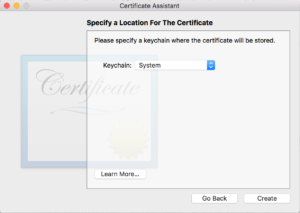
You need to create a certificate and sign gdb. By doing so you're telling the operating system that gdb is authorized to attach to other processes for debugging purposes. The following instructions have been taken from this guide. Open application 'Keychain Access' (/Applications/Utilities/Keychain Access.app). In Keychain Access, select the 'login' keychain in the 'Keychains' list in the upper left hand corner of the window. Open the menu item in /Keychain Access/Certificate Assistant/Create a Certificate. Choose a name ('lldbcodesign' in the example, but you can use anything you want), set 'Identity Type' to 'Self Signed Root', and set 'Certificate Type' to 'Code Signing'.
Click 'Create'. Click continue, continue and done. Click on the “My Certificates” category on the left side and double click on the new “lldbcodesign” certificate. Open the context menu for 'Trust' (click the triangle) and change the following: When using this certificate: Always Trust. Now close this window, and enter your login password to confirm this change.
Option-drag (this meaning holding the option key down and dragging) the new 'lldbcodesign' certificate from the login keychain to the System keychain in the Keychains pane of the main Keychain Access window to make a copy of this certificate in the System keychain. You'll have to authorize a few more times, set it to be 'Always trusted' when asked. Switch to the 'System' keychain and drag a copy of the 'lldbcodesign' you just made onto the Desktop. Switch to Terminal and then run the following command (copy paste it!): sudo security add-trust -d -r trustRoot -p basic -p codeSign -k /Library/Keychains/System.keychain /Desktop/lldbcodesign.cer. Then right click on the 'lldbcodesign' certificate in the 'System' keychain (not 'Login') and select 'delete' to delete it from the 'System' keychain.
Then reboot your system/computer. Finally you can sign gdb: codesign -s lldbcodesign /usr/local/bin/gdb. If this command doesn't work.then panic! Just kidding, be sure that you have gdb installed and that gdb is actually installed in /usr/local/bin. You may want to try 'which gdb' in your Terminal to figure out where it is. Finally, remove the lldbcodesign.cer file that's sitting on your desktop, and gdb should be working at this point.:).
How to Debug Using GDB How to Debug Using GDB We are going to be using two programs to illustrate how GDB can be used to debug code. Debugging a program with a logical error The first sample program has some logical errors. The program is supposed to output the summation of (X^0)/0! + (X^n)/n!, given x and n as inputs. However the program outputs a value of infinity, regardless of the inputs.

We will take you step by step through the debugging process and trace the errors:. Download the sample program. Compile the program and execute the program.% g -g broken.cpp -o broken%./broken Whatever the input, the output will be inf.
The -g option is important because it enables meaningful GDB debugging. Start the debugger% gdb broken This only starts the debugger; it does not start running the program in the debugger.
Look at the source code and set a breakpoint at line 43 (gdb) b 43 which is double seriesValue = ComputeSeriesValue(x, n);. Now, we start to run the program in the debugger.
(gdb) run Note: If you need to supply the command-line arguments for the execution of the program, simply include them after the run command, just as normally done on the command line. The program starts running and asks us for the input. Let's enter the values as x=2 and n=3. The expected output value is 5. The following is a snapshot of the program running in the debugger: This program is used to compute the value of the following series: (x^0)/0! Please enter the value of x: 2 Please enter an integer value for n: 3 Breakpoint 1, main at broken.cpp:43 43 double seriesValue = ComputeSeriesValue(x, n); Note that the program execution stopped at our first (and only) breakpoint. Step into the ComputeSeriesValue function To step into a function call, we use the following command: (gdb) step ComputeSeriesValue (x=2, n=3) at broken.cpp:17 17 double seriesValue=0.0; At this point, the program control is at the first statement of the function ComputeSeriesValue (x=2, n=3).
Next let's step through the program until we get into ComputeFactorial. (gdb) next 18 double xpow=1; (gdb) n 20 for (int k = 0; k.